
Last updated March 15, 2026 by the Recommended.app research team.
Space Center Houston: The Real Deal
Let's get this out of the way first — yes, you absolutely need to visit Space Center Houston. This isn't some cheesy tourist attraction with a gift shop slapped onto a parking lot. This is the official visitor center of NASA's Johnson Space Center, where actual astronauts train and Mission Control still operates. The $29.95 admission ($24.95 for kids) gets you into the main complex, but the real magic is the NASA Tram Tour that takes you behind the scenes to see Mission Control and the astronaut training facility.
The Level 9 Tour is the insider move here — it's a more in-depth, 4-5 hour experience that costs around $179.95 per person, but you'll walk through areas that the regular public never sees, including the actual International Space Station mission control room. You'll need to book it weeks in advance because it's limited to 12 people per tour. If you can swing the cost, it's legitimately one of the most unique experiences you can have in any American city.
Plan for at least 4-5 hours at the regular Space Center. The Independence Plaza exhibit lets you walk through a replica shuttle mounted on top of the original NASA 905 shuttle carrier aircraft. The Starship Gallery has actual moon rocks you can touch — one of only a handful of places on Earth where you can do that. Don't skip the short films in the theater; they're genuinely moving, even if you're not a space nerd.
The center is about 30 minutes southeast of downtown Houston in Clear Lake, so factor in drive time. Traffic on I-45 South can be brutal during rush hour, so aim to arrive when the doors open at 10 AM on weekdays. Weekends are predictably packed — Saturday mornings before 11 AM are your best bet if you can't go during the week.
Pro tip: Download the Space Center Houston app before you go. It has a GPS-guided tour feature that tells you exactly what you're looking at, and it alerts you to live demonstrations happening throughout the day. The astronaut meet-and-greets aren't advertised well — the app is the only reliable way to know when they're happening.
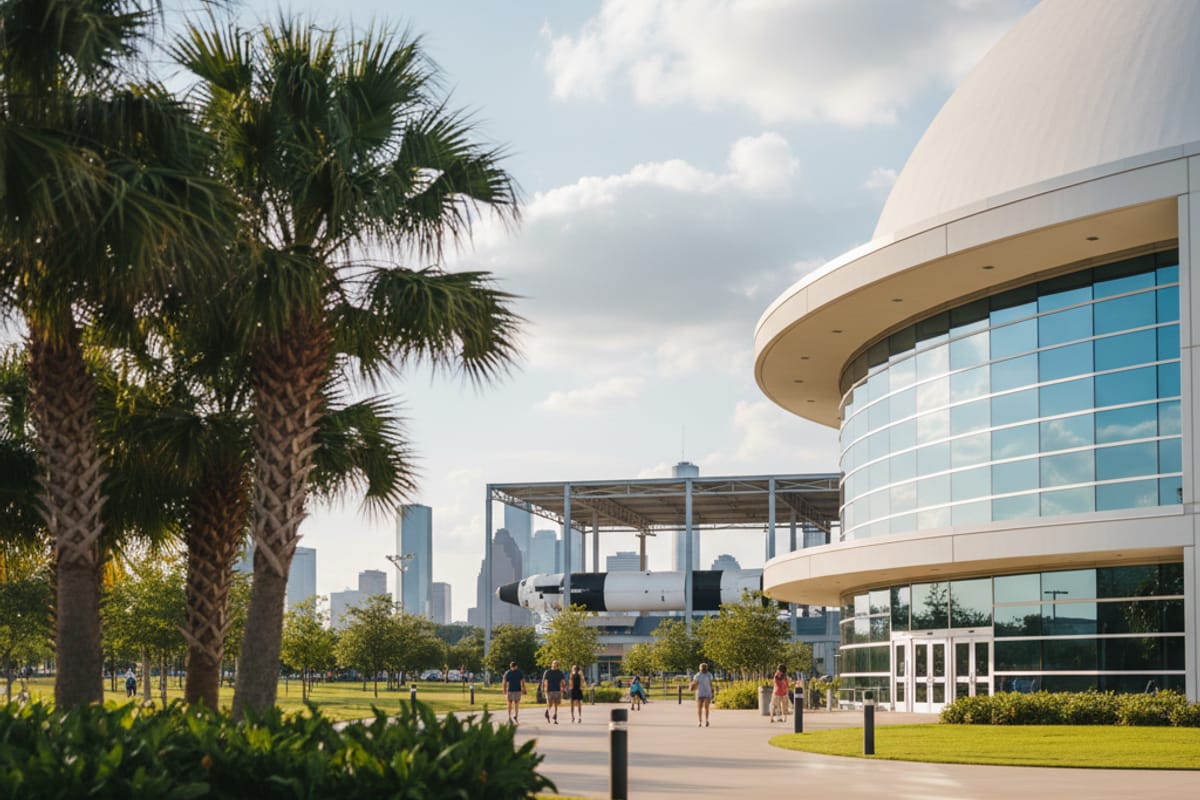 Space Center Houston — where you can touch actual moon rocks and walk through Mission Control.
The Museum District: 19 Museums, Many of Them Free
Houston's Museum District is one of the most underrated cultural zones in America. Within a 1.5-mile radius, you'll find 19 museums — and several of the best ones are completely free. The Menil Collection is a world-class modern art museum with works by Warhol, Magritte, and Cy Twombly, and it never charges admission. The Rothko Chapel next door is a non-denominational meditation space with 14 massive Mark Rothko paintings — it's hauntingly beautiful and also free.
The Museum of Fine Arts, Houston (MFAH) is the largest art museum in the Southwest, with over 70,000 works spanning 6,000 years. General admission is $19 for adults, but here's the local secret: it's free every Thursday. The Kinder Building, which opened in 2020, is architecturally stunning — designed by Steven Holl with translucent panels that glow at night. Inside, the Latin American art collection is one of the finest in the world.
The Houston Museum of Natural Science is another heavyweight — the permanent exhibit halls are free (you read that right), while special exhibits and the planetarium run about $12-25 each. The paleontology hall has one of the best dinosaur skeleton collections in the country, and the gem and mineral vault is mesmerizing. Kids will lose their minds here.
The Contemporary Arts Museum Houston (CAMH) is always free and rotates bold, challenging exhibitions that feel nothing like a traditional museum. The Buffalo Soldiers National Museum, the Holocaust Museum Houston, and the Children's Museum Houston (which charges $14 but is worth every penny for families) round out the district. You could easily spend two full days here and not see everything.
The district is centered around Hermann Park, which itself is a destination — 445 acres of gardens, a golf course, pedal boats on McGovern Lake, and the Hermann Park Railroad, a miniature train that's been running since 1958. Grab a bench near the reflecting pool outside the MFAH and just sit for a while. It's one of the most peaceful spots in the city.
Pro tip: MFAH free Thursdays get crowded after 3 PM when school groups arrive. Go between 10 AM and noon for a much quieter experience. Also, the museum's Cullinan Hall hosts free jazz concerts on Thursday evenings — combine it with your free admission for a complete evening out that costs nothing.
Montrose: Houston's Coolest Neighborhood
If Houston has a soul, it lives in Montrose. This centrally located neighborhood west of downtown is Houston's creative heart — a sprawling mix of vintage shops, murals, dive bars, art galleries, LGBTQ+ nightlife, and some of the best restaurants in the city. Montrose doesn't look like the rest of Houston; the streets are tree-lined and walkable (a rarity here), the houses range from bungalows to mid-century modern gems, and there's a rebellious energy that's been alive since the 1960s.
Start your Montrose morning at Blacksmith, a coffee shop in a restored 1910 bungalow run by the team behind Underbelly Hospitality (one of Houston's most acclaimed restaurant groups). Their cortado is excellent, and the back patio is a perfect spot to ease into the day. From there, walk down Westheimer Road — this strip is the backbone of Montrose, packed with shops like Cactus Music (one of the best independent record stores in America), Space Montrose (eclectic gifts and art), and dozens of vintage clothing stores.
For lunch, Uchi Houston on Westheimer serves some of the best Japanese food in the South — their hot rock wagyu is life-changing, though the lunch specials are more wallet-friendly than dinner. If you want something more casual, Torchy's Tacos on West Alabama does creative Tex-Mex that'll ruin Taco Bell for you forever. The Trailer Park Trashy (a fried chicken taco with green chiles and queso) is the move.
The Menil Collection and Rothko Chapel are technically in Montrose, so you can combine your museum visit with neighborhood exploration. In the evening, Montrose transforms — Anvil Bar & Refuge on Westheimer is consistently ranked among the best cocktail bars in America. Their bartenders don't use a menu; tell them what flavors you like and they'll build something extraordinary. Poison Girl is the dive bar counterpart — cheap beer, great jukebox, and a patio where you'll inevitably make friends with strangers.
Don't miss the street art. Montrose has some of Houston's most photographed murals — the "Houston Is Inspired" mural on West Alabama and the "Be Someone" graffiti on the railroad bridge over I-45 (technically just outside Montrose but a Houston icon). These are genuinely impressive public art installations, not just Instagram backdrops.
Pro tip: Montrose parking is free on residential streets but limited on Westheimer during weekends. The neighborhood is surprisingly bikeable — Houston BCycle has stations throughout Montrose, and a day pass is just $9. It's the best way to cover ground between the Menil, shops, and restaurants without dealing with parking.
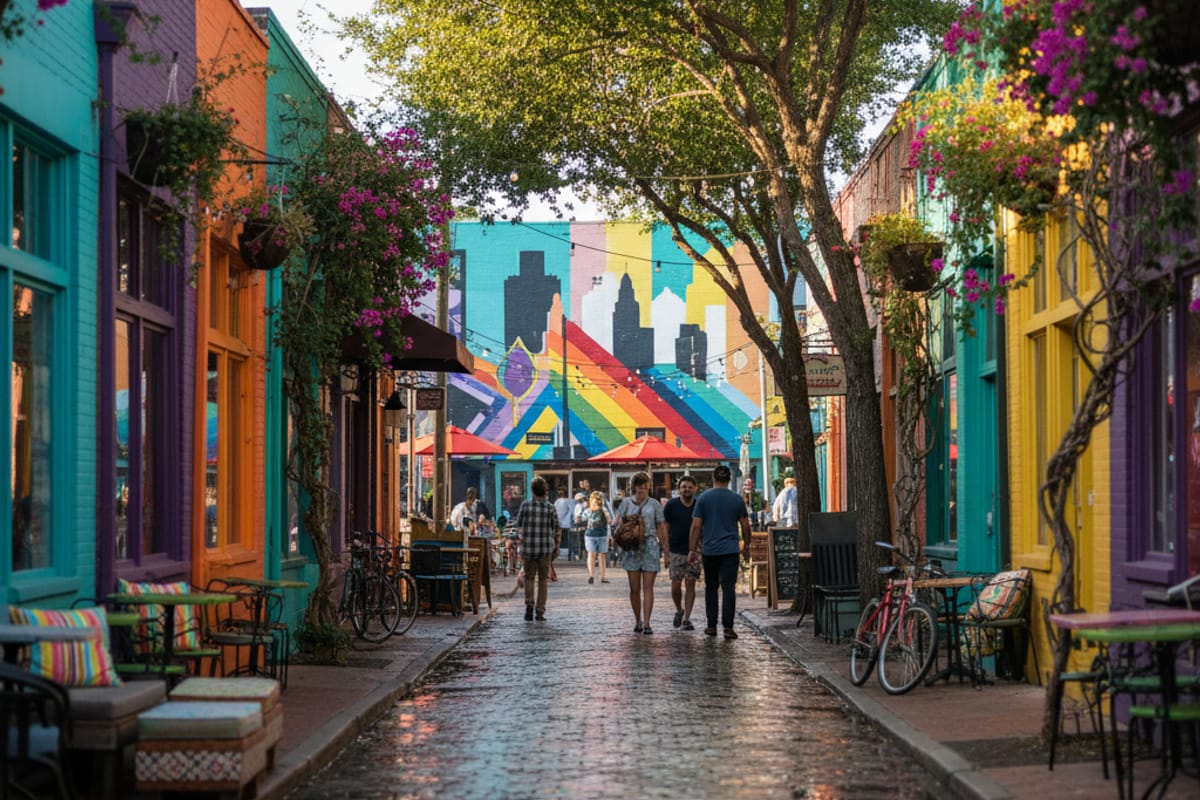 Montrose — Houston's creative, walkable heart.
Chinatown & Bellaire Boulevard: The Food Scene That Changes Everything
Houston's Chinatown isn't a quaint three-block district with a decorative gate — it's a massive, sprawling corridor along Bellaire Boulevard in southwest Houston that stretches for miles and contains what many food writers consider the best concentration of Asian food in the United States outside of the West Coast. This is where Houston's diversity stops being a talking point and becomes a fork-in-your-hand reality.
The Bellaire Boulevard corridor is anchored by several enormous Asian shopping centers — the Hong Kong Food Market, Jusgo Supermarket, and 99 Ranch Market are destinations unto themselves. Inside these malls, you'll find food courts that would be considered destination restaurants in other cities. The food court inside the Hong Kong City Mall has hand-pulled noodle shops, Taiwanese shaved ice stands, and dim sum counters that rival anything in San Gabriel Valley.
For sit-down dining, the options are staggering. Crawfish & Noodles combines two Houston obsessions — Viet-Cajun crawfish (a Houston invention, by the way) with traditional Vietnamese noodle soups. Their garlic butter crawfish is transcendent, and a plate with noodles runs about $16-20. Mala Sichuan Bistro on Bellaire does fiery, authentic Sichuan cuisine — the dry pot with your choice of protein is $15-18 and will make your eyes water in the best way. Pho Binh by Night on Bellaire serves some of the city's best pho in a converted trailer behind a gas station — a large bowl is $12 and it's been perfected over decades.
Don't overlook the Korean options — Jang Guem on Longpoint does spectacular Korean BBQ where you grill premium meats at your table for about $25-35 per person. For dim sum, Ocean Palace on Bellaire is the classic choice — go on a weekend morning before 11 AM, expect a wait, and prepare for rolling carts piled with har gow, siu mai, and turnip cakes. The bill for two people rarely tops $30.
The real secret of Houston's Chinatown is that it's not just Chinese. Within a five-mile radius, you'll find exceptional Vietnamese, Thai, Malaysian, Indonesian, Japanese, Korean, Indian, and Pakistani food. Banana Leaf on Bellaire does Malaysian food that's virtually impossible to find at this quality level elsewhere in the South. Their roti canai and nasi lemak are textbook perfect and cost under $15.
Pro tip: Many of the best Chinatown restaurants are cash-only or have minimum card purchase amounts. Bring at least $40-60 in cash per person. Also, Google Maps ratings here are unreliable — a restaurant with 3.8 stars in Houston's Chinatown would be a 4.5 anywhere else. Trust the crowded parking lots as your review system.
Buffalo Bayou Park: Houston's Green Ribbon
Houston gets a bad reputation as a sprawling concrete jungle, and honestly, much of that criticism is fair. But Buffalo Bayou Park is the stunning exception — a 160-acre linear park along the banks of Buffalo Bayou that stretches from Shepherd Drive to downtown, connecting some of the city's best neighborhoods with walking trails, public art, gardens, and skyline views that'll make you rethink everything you assumed about Houston.
The park underwent a $58 million transformation completed in 2015, and it shows. The hike-and-bike trails are immaculate — you can walk or run the full 3-mile loop along the bayou, crossing the Rosemont Pedestrian Bridge for one of the best skyline photo opportunities in the city. The Barbara Fish Daniel Nature Play Area is a natural playground built from fallen trees and boulders that kids go absolutely wild over. The Johnny Steele Dog Park is one of the best urban off-leash areas in Texas, with separate sections for large and small dogs and direct bayou access.
Rent a kayak or stand-up paddleboard from the park's outfitter near the Lost Lake visitor center — a single kayak rental runs about $25-35 for 90 minutes, and paddling beneath the downtown bridges while the skyline rises above you is a surreal experience. Sunset paddles are particularly stunning. The Waugh Drive Bridge colony is home to around 300,000 Mexican free-tailed bats that emerge at dusk from under the bridge in a dramatic spiral — it's free to watch and one of Houston's most underrated natural spectacles.
The park connects to the broader bayou trail system that eventually stretches over 150 miles across Harris County. If you're a runner or cyclist, the trails east from the park toward the East End lead through some fascinating transitional neighborhoods — old warehouses converting to breweries, street art appearing on every surface, and the kind of raw urban energy that makes Houston feel like a city in the middle of reinventing itself.
For food near the park, The Dunlavy is a stunning glass-walled event space and cafe right on the bayou that serves excellent brunch and lunch — their avocado toast and grain bowls are around $14-18. It's Instagram-famous for a reason, but the food genuinely delivers. Alternatively, walk north from the park into Montrose for more options.
Pro tip: The Waugh Drive bat colony emergence happens every evening at dusk, but the best viewing months are March through October when the colony is largest. Stand on the south side of the bayou near the observation platform — you'll see (and hear) the bats streaming out from beneath the bridge in massive waves. Arrive 20 minutes before sunset for a good viewing spot.
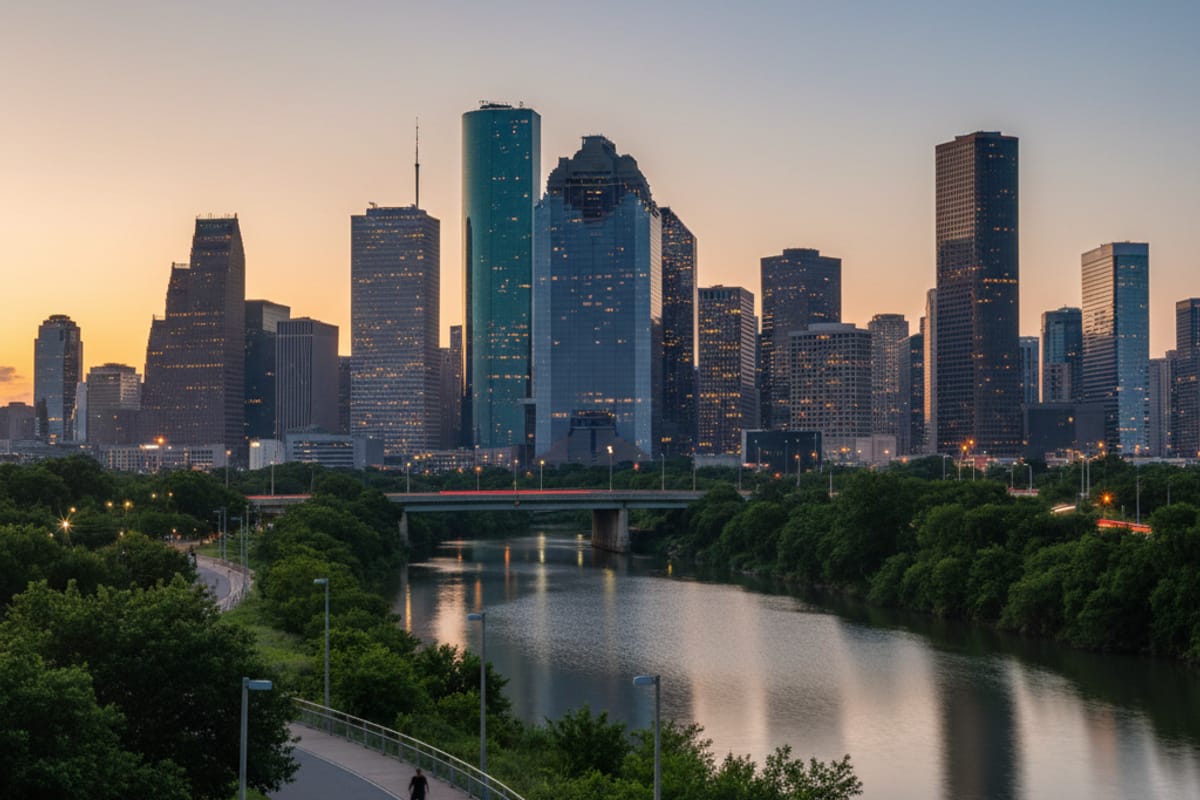 Buffalo Bayou Park — 160 acres of trails, art, and skyline views.
Budget Tips: Houston Is Cheaper Than You Think
Houston is significantly more affordable than other major cities for visitors, and knowing a few tricks makes it even better. Hotels in the Medical Center area and Galleria district often run $90-130/night for quality properties, and downtown hotels drop to $80-110 on weekends when business travelers leave. The Hotel ZaZa in the Museum District is Houston's boutique icon — watch for midweek rates around $160 that would be $350+ for equivalent properties in New York or LA.
Food is where Houston really shines on a budget. You can eat world-class international food for $8-15 per meal in Chinatown, Hillcroft (the Mahatma Gandhi District), and the East End. A massive bowl of pho with all the fixings at Pho Saigon on Milam Street is $11. A full plate of chicken biryani at Himalaya on Hillcroft is $13. A torta from any of the taquerias on Airline Drive is $6-8 and the size of your head. You can eat three exceptional meals a day for under $35 if you're willing to explore beyond downtown.
Transportation is the one area where Houston demands some planning. The city is enormous — the Greater Houston metro area is bigger than the state of New Jersey — and public transit, while improving, is limited. The METRORail Red Line runs from downtown through the Museum District to NRG Park and is useful for those specific corridors ($1.25 per ride). For everything else, you'll likely need a car or rideshare. Uber and Lyft rides within the 610 Loop typically run $8-15.
Free activities beyond the museums: Miller Outdoor Theatre in Hermann Park hosts free performances (everything from Shakespeare to the Houston Symphony) from March through November — just show up with a blanket. Discovery Green downtown is a 12-acre park with free yoga, concerts, and movie screenings. The San Jacinto Battleground State Historic Site (where Texas won its independence) is free to visit and the museum is excellent. Galveston Island is 50 minutes south and the Seawall is free to walk, though the beaches charge $12 for parking.
Realistic budget for a 3-day Houston trip: $400-650 per person including hotel, food, Space Center Houston admission, and transportation. That's for a genuinely excellent experience — not a bare-bones survival trip. Houston is one of the best value destinations in America, and it's not even close.
Pro tip: The Houston CityPASS ($64 for adults) bundles Space Center Houston, the Downtown Aquarium, Houston Museum of Natural Science, and the Houston Zoo or Children's Museum. If you're planning to hit three or more of these, it saves 47% versus buying individual tickets. Buy it online before your trip — the digital pass works immediately.
Why Trust This Guide
Recommendations from locals across 240+ US cities via Recommended.app community data.
Explore More
Related guides:
This guide is part of our Houston collection. Explore more guides for Houston →
Houston has 869 verified businesses on Recommended.app across 91 categories, with an average rating of 4.6 out of 5.
Hidden Gems Weekly
3 hidden gems, 2 local quotes, 1 home hack — every Monday. Free forever.
Unsubscribe anytime. No spam.
More from City Guides
 City Guide
We Asked Houston Locals Where They Actually Eat — Here's What They Said
 City Guide
Houston Hidden Gems Even Houstonians Forget Exist
 Home Services
Water Damage Restoration Near Me: What to Do in the First 24 Hours (2026 Guide)
 Food & Dining
Best Buffet in Las Vegas 2026: What's Still Worth It After the Great Buffet Collapse
 Food & Dining
Best Coffee Shops in Chicago 2026: 20 Cafes Worth Leaving Your Apartment For
 Food & Dining