
Last updated March 16, 2026 by the Recommended.app research team.
Beale Street: The Beating Heart of Memphis Music
There is no understanding Memphis without understanding Beale Street. This three-block stretch of neon signs, open doors, and live blues pouring out onto the sidewalk is where the American soundtrack was written. W.C. Handy stood on this street and codified the blues into sheet music for the first time. B.B. King played these clubs before the world ever knew his name. And today, every single night of the week, you can walk down Beale Street and hear live music spilling out of a dozen venues without paying a single cover charge.
Start at the corner of Beale and Second Street and walk east. The clubs line both sides — B.B. King's Blues Club is the anchor, a massive venue with a house band that plays nightly and touring acts on weekends. Across the street, Rum Boogie Café has walls covered with signed guitars and a blues band that will make you forget what city you thought you were visiting. Silky O'Sullivan's is the rowdy one, with dueling pianos and a beer garden where goats wander around (yes, actual goats — it's a Memphis thing). King's Palace Café is where you duck in when you want excellent Cajun food and a slightly quieter atmosphere.
The best time to experience Beale Street is Thursday through Saturday after 8 PM, when the street closes to traffic and becomes a pedestrian party. But here is the local secret: go on a Tuesday or Wednesday night instead. The crowds thin out, the musicians play longer sets because they're not rushing between shows, and you can actually talk to the bartenders. The music is just as good — in some cases better, because the performers are playing for the love of it, not just the weekend tips.
One thing to know: the very end of Beale Street, past Fourth Street, gets quieter and a bit rougher. Stick to the main three-block stretch between Second and Fourth for the best experience, especially at night. And don't miss the Beale Street Brass Note Walk of Fame embedded in the sidewalk — bronze notes honoring legends like B.B. King, Memphis Minnie, Bobby Blue Bland, and Rufus Thomas. Most visitors walk right over them without looking down.
Pro tip: Most Beale Street clubs don't charge a cover, but they do require a drink minimum (usually one drink). Bring cash for tips — the musicians rely on the tip jar. A $5-10 tip per set is standard and appreciated.
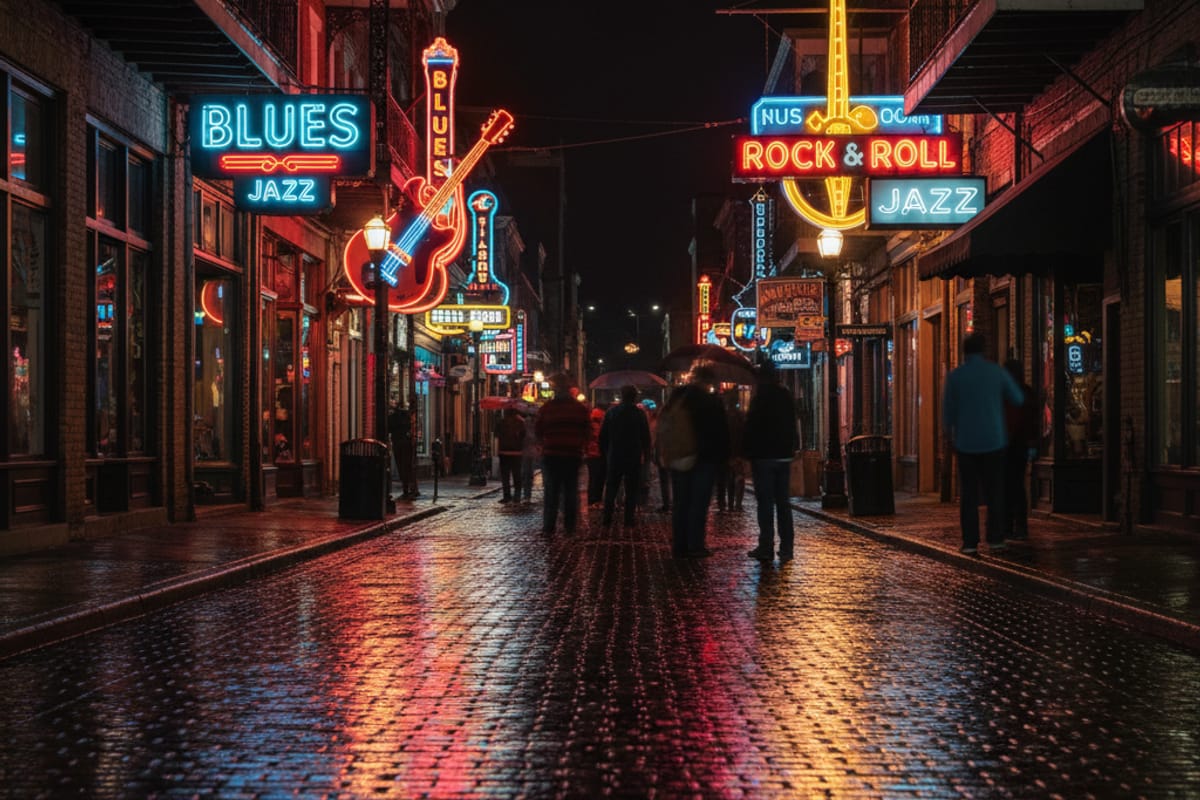 Beale Street — where the blues were born and still live every single night.
Graceland: Elvis Presley's Home and Legacy
You do not have to be an Elvis fan to appreciate Graceland. You just have to be a human being who is curious about how a poor kid from Tupelo, Mississippi, became the most famous entertainer in the world and then lived in this deeply strange, deeply human house until he died at 42. Graceland is not a museum in the traditional sense — it is a time capsule. The rooms have been preserved almost exactly as they were when Elvis lived there, and that is what makes it fascinating.
The Jungle Room, with its green shag carpet on the ceiling and Polynesian furniture, is wonderfully bizarre. The TV room, where Elvis famously shot a television set because he didn't like what was on, still has three TVs mounted side by side (he watched all the networks simultaneously). The racquetball court where he played his last game is now a trophy room displaying his gold records, jumpsuits, and awards. And the Meditation Garden, where Elvis is buried alongside his parents and grandmother, is genuinely moving regardless of how you feel about his music.
The new Elvis Presley's Memphis entertainment complex across the street houses his car collection, his two private planes (including the Lisa Marie, a full Convair 880 jet with a living room and gold-plated seatbelt buckles), and rotating exhibits about his life. The entire experience takes about three to four hours if you do everything.
Tickets are not cheap — the basic mansion tour runs about $45, and the full VIP experience with all exhibits is closer to $80. But here is the thing: it is worth it. Even the most skeptical visitors come out of Graceland understanding something about American culture they didn't before. The audio tour is narrated by John Stamos, which is an odd choice, but it works surprisingly well.
Book your tickets online in advance, especially if you are visiting during Elvis Week in August (the week surrounding the anniversary of his death on August 16). That week, Graceland is packed with fans from around the world, and the candlelight vigil at the Meditation Garden is one of the most emotional public gatherings you will ever witness. If crowds are not your thing, visit on a weekday morning in the off-season. You will practically have the mansion to yourself.
Pro tip: The basic mansion tour is sufficient for most visitors. The VIP upgrades add car museums and plane tours but take the total visit to 4+ hours. If you're short on time, the mansion itself is the must-see.
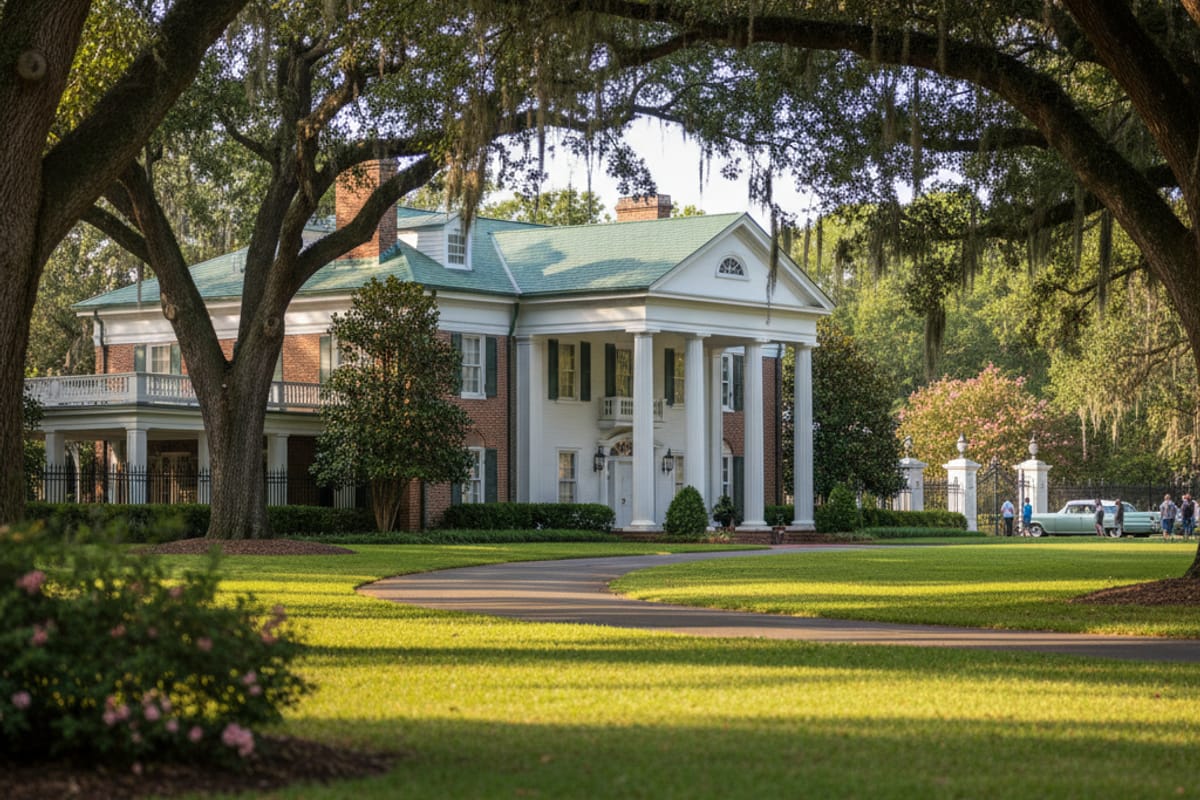 Graceland — still the second most-visited private residence in America after the White House.
Sun Studio: Where Rock 'n' Roll Was Born
Sun Studio is a small, unassuming brick building on Union Avenue that happens to be the most important recording studio in the history of American popular music. This is where Sam Phillips recorded Elvis Presley, Johnny Cash, Jerry Lee Lewis, Carl Perkins, Roy Orbison, and Howlin' Wolf. This is where rock and roll was literally invented — where the collision of blues, country, and gospel created something entirely new that changed the world.
The guided tour takes about 45 minutes and it is one of the best tours in America. The guides are musicians themselves, and they don't just recite facts — they tell stories. You will hear the original recordings played on the actual equipment, stand on the X on the floor where Elvis stood when he recorded 'That's All Right' in 1954, and hold the same microphone that Johnny Cash used for his early recordings. The acoustics of the room are still exactly as they were in the 1950s. Sun Studio still operates as a working recording studio at night, and modern artists pay a premium to record in the same room.
The tour costs about $15, which is one of the best deals in Memphis. It runs every half hour, and you don't need a reservation for most of the year, though summer weekends can get busy. There is also a free shuttle that runs between Sun Studio, Graceland, and the Rock 'n' Soul Museum, which is a smart way to connect the music dots without paying for parking three times.
What makes Sun Studio special is not just what happened there — it is that you can feel it. The room is small enough that you can imagine exactly how it sounded when four young men gathered around one microphone in December 1956 for what became the Million Dollar Quartet session — Elvis, Cash, Lewis, and Perkins, all jamming together spontaneously. Sam Phillips left the tape running. That recording exists because of this room.
Don't skip the gift shop on the first floor. It has a surprisingly good selection of vinyl records, and the espresso bar serves solid coffee. The studio itself is upstairs, and the anticipation of climbing those stairs — knowing what happened in the room at the top — is part of the experience.
Pro tip: Sun Studio offers a free shuttle between the studio, Graceland, and the Rock 'n' Soul Museum on Beale Street. It runs every hour and saves you parking fees and hassle at all three locations.
The National Civil Rights Museum: Essential and Unforgettable
The National Civil Rights Museum is built around the Lorraine Motel, where Dr. Martin Luther King Jr. was assassinated on April 4, 1968. The balcony where he was standing is preserved exactly as it was, with a wreath marking the spot. Room 306, where he was staying, is visible through the window. It is a gut-punch of a sight, and the museum that surrounds it is one of the most powerful and important museums in America.
The museum traces the entire history of the civil rights movement in America, from the beginning of resistance to slavery through the modern era. The exhibits are immersive and unflinching. You will walk through a replica of the bus where Rosa Parks refused to give up her seat. You will sit at a recreated Woolworth's lunch counter and listen to audio of the actual abuse that sit-in protesters endured. You will see the burned shell of a Freedom Rider bus and read the actual threatening letters sent to Dr. King.
Plan to spend at least two to three hours here. Many visitors spend longer. The museum is emotionally intense, and that is by design — it respects the weight of the history it tells. There are moments where you will need to pause. The room documenting the assassination itself, with the view from the window across Mulberry Street to the balcony, is almost unbearable in its specificity.
The museum also includes the boarding house across the street from which James Earl Ray fired the shot. This section traces the investigation and the broader context of the assassination. It is deeply detailed and deeply disturbing.
Admission is about $18 for adults, and on Mondays from 3 to 5 PM it is free (the museum is closed on Tuesdays). The Monday afternoon free hours are obviously popular, so arrive early if you want to avoid a long wait. For the fullest experience, go on a weekday morning when the crowds are thinnest and you can take your time with each exhibit.
This is not a fun outing in the traditional sense. It is a necessary one. Every American should visit this museum at least once, and most visitors describe it as one of the most important experiences of their lives. Come prepared emotionally, and give yourself time afterward to sit quietly — there are benches in the courtyard outside that seem designed for exactly that purpose.
Pro tip: Monday afternoons from 3-5 PM offer free admission. Arrive by 2:30 PM to get in line. The museum is closed on Tuesdays. Allow 2-3 hours minimum for the full experience.
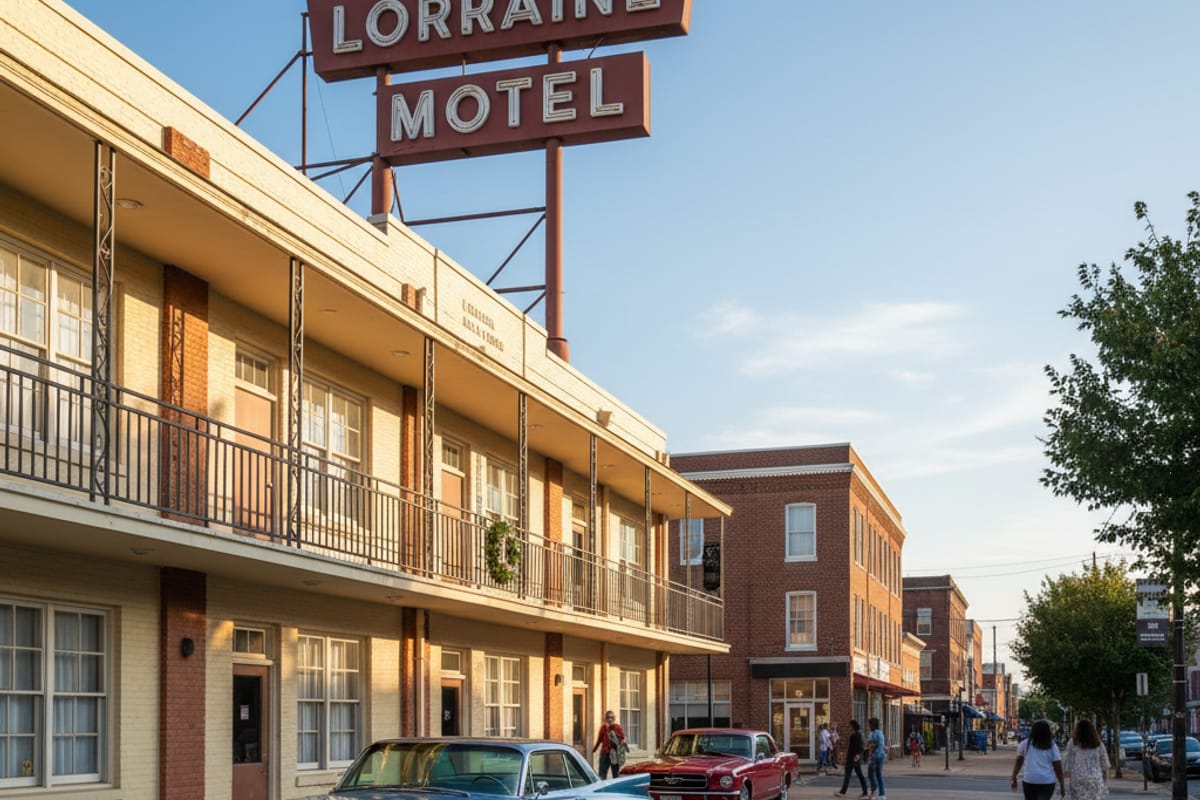 The Lorraine Motel — preserved as a powerful memorial and world-class museum.
Memphis BBQ: A Holy Trinity of Smoke and Sauce
Memphis is one of the four great American BBQ cities, and locals will argue it is the greatest. The Memphis style is defined by pork — pulled pork shoulders and dry-rubbed ribs — and the debate between wet ribs (mopped with sauce) and dry ribs (coated in a spice rub with no sauce) is the closest thing this city has to a religious schism. You need to try both, and the three restaurants you absolutely cannot miss are Central BBQ, Charlie Vergos' Rendezvous, and Payne's Bar-B-Q.
Central BBQ is the modern standard-bearer. With locations on Central Avenue and in downtown near the ballpark, Central serves pulled pork that is smoky, tender, and deeply flavorful. Their BBQ nachos — a mountain of tortilla chips buried under pulled pork, cheese, and jalapeños — are legendary. The ribs are excellent whether you get them wet or dry. The Central Avenue location has a patio and a more relaxed neighborhood vibe. This is the spot most locals will recommend first, and for good reason.
Charlie Vergos' Rendezvous is the famous one. Located in an alley off General Washburn Alley downtown, Rendezvous has been serving dry ribs since 1948. The basement dining room is covered with decades of memorabilia. The ribs here are not smoked in the traditional sense — they are cooked over charcoal and then seasoned with a proprietary dry rub that has been a family secret for three generations. The result is a unique rib that is drier and more seasoned than what you get elsewhere, with a distinctive vinegary tang. People either love Rendezvous or think it is overrated. You have to try it and decide for yourself. Go for dinner — the atmosphere at night, in that basement, with a cold beer and a full slab, is quintessential Memphis.
Payne's Bar-B-Q is the one the locals guard jealously. This tiny cinderblock building on Lamar Avenue has been serving chopped pork sandwiches since 1972. There is no ambiance. There are no frills. The sandwich is pork, slaw, and sauce on white bread, and it costs about six dollars, and it is one of the best things you will ever eat. The sauce is thin and tangy, the pork is chopped (not pulled — there is a difference, and Payne's will teach you why it matters), and the coleslaw is cool and crunchy. Get two sandwiches because you will want another one immediately after finishing the first. Cash only.
Beyond these three, Memphis has dozens of excellent BBQ joints. The Bar-B-Q Shop on Madison Avenue has an outstanding BBQ spaghetti (a Memphis invention — spaghetti topped with pulled pork and BBQ sauce that sounds wrong but tastes incredibly right). Interstate Barbecue on South Third Street was the domain of the late Jim Neely, and its rib tips remain some of the best in the city. Tom's BBQ on Getwell Road is a no-frills window-service operation with loyal regulars who would never eat anywhere else.
The golden rule of Memphis BBQ: if the restaurant has a drive-through window, a hand-lettered sign, and smoke rolling out of a pit in the back, you are almost certainly in the right place.
Pro tip: Rendezvous is closed on Sundays and Mondays. Payne's is cash only and closes when they run out of meat, usually by mid-afternoon. Central BBQ is the safest bet for consistent hours and availability. For the full Memphis BBQ experience, hit all three on different days.
Budget Tips and Practical Advice for Memphis
Memphis is one of the most affordable major cities in the South for visitors. Hotels downtown run $100-150 per night, and you can find solid options near Beale Street for under $120. The Guest House at Graceland is the premium option if you want to stay near Elvis's home (around $180-250/night), but there are plenty of budget chains on Elvis Presley Boulevard for $70-90.
Food is remarkably cheap. A full BBQ meal at Central or Rendezvous costs $15-25 per person with sides and a drink. Payne's and other neighborhood joints run $6-10. A plate lunch at a soul food restaurant like The Four Way on Mississippi Boulevard — fried catfish, mac and cheese, collard greens, and cornbread — is about $12 and will fill you for the rest of the day.
The free things in Memphis are some of the best things. Walking Beale Street and listening to live music costs nothing (though you should tip the musicians). The Mississippi River Greenbelt Park and the Big River Crossing — a pedestrian bridge that lets you walk across the Mississippi into Arkansas and back — are free and spectacular, especially at sunset. Overton Park, home to the Memphis Zoo, the Memphis Brooks Museum of Art, and old-growth forest trails, is a beautiful green space in the middle of the city.
Getting around Memphis is easiest by car, and parking is generally cheap ($5-10 in downtown lots). The Main Street Trolley runs along the Main Street corridor for $1 per ride and connects the South Main district with downtown and Beale Street. Ride-shares are plentiful and affordable — a ride from downtown to Graceland runs about $12-15.
The best time to visit Memphis is in the spring (April-May) or fall (September-October) when the weather is warm but not oppressive. Summers in Memphis are brutally hot and humid — July and August regularly hit 95-100 degrees with high humidity that makes it feel even hotter. If you come in summer, plan indoor activities for the afternoon and save your walking for early morning and evening.
Realistic budget for a 3-day Memphis trip: $600-900 per person including hotel, food, Graceland ($45-80), Sun Studio ($15), Civil Rights Museum ($18), and spending money for Beale Street. That gets you a deeply rich experience in a city that punches way above its weight in music, food, and history. Memphis does not try to impress you with flash. It impresses you with soul.
Why Trust This Guide
Recommendations from locals across 240+ US cities via Recommended.app community data.
Explore More
Related guides:
This guide is part of our Memphis collection. Explore more guides for Memphis →
Memphis has 228 verified businesses on Recommended.app across 75 categories.
Hidden Gems Weekly
3 hidden gems, 2 local quotes, 1 home hack — every Monday. Free forever.
Unsubscribe anytime. No spam.
More from City Guides
 City Guide
Memphis Hidden Gems: Beyond Beale Street and Graceland
 City Guide
We Asked Memphis Locals Where They Actually Eat — Here's What They Said
 Home Services
Water Damage Restoration Near Me: What to Do in the First 24 Hours (2026 Guide)
 Food & Dining
Best Buffet in Las Vegas 2026: What's Still Worth It After the Great Buffet Collapse
 Food & Dining
Best Coffee Shops in Chicago 2026: 20 Cafes Worth Leaving Your Apartment For
 Food & Dining