
Last updated March 16, 2026 by the Recommended.app research team.
Palm Canyon Drive: The Heart of Downtown Palm Springs
Palm Canyon Drive is where Palm Springs comes alive, and it's the natural starting point for any first visit. This main drag runs through the center of town with a walkable stretch of about a mile packed with boutiques, galleries, restaurants, and bars — all set against a backdrop of the San Jacinto Mountains that makes you feel like you're on a movie set. Because, in a sense, you are. This town has been a Hollywood retreat since the 1930s, and that glamour still lingers in the architecture and the attitude.
Start your morning at Ernest Coffee on the north end — a local favorite with excellent cold brew and a shaded patio that catches the mountain breeze. From there, walk south and let yourself wander. You'll pass vintage shops selling mid-century furniture, art galleries with desert-inspired work, and souvenir stores that range from kitschy to genuinely cool. The Rowan hotel's rooftop pool bar, 4 Saints, offers panoramic views of the mountains and is worth a stop even if you're not staying there.
On Thursday evenings from October through May, Palm Canyon Drive closes to traffic for VillageFest — a street fair with live music, food vendors, artists, and craftspeople. It draws locals and visitors alike, and the energy is completely different from the daytime vibe. The tamales from the street vendors are legitimately some of the best you'll find anywhere in the Coachella Valley. Get there by 6 PM to snag parking nearby; by 7 PM you'll be circling blocks.
The restaurant scene along Palm Canyon has improved dramatically in recent years. Workshop Kitchen + Bar occupies a stunning converted theater space with exposed brick and towering ceilings — the wood-fired dishes are excellent and the cocktail program is serious. For something more casual, Birba serves pizzas and Italian small plates on a patio strung with lights that feels like a scene from a European vacation. Both fill up on weekends, so make reservations or plan to eat early.
Pro tip: Parking is free along Palm Canyon Drive for the first two hours and in the city-owned lots. Don't pay for a garage unless it's VillageFest night — even then, the lots behind the Hyatt on Tahquitz Canyon Way are usually available.
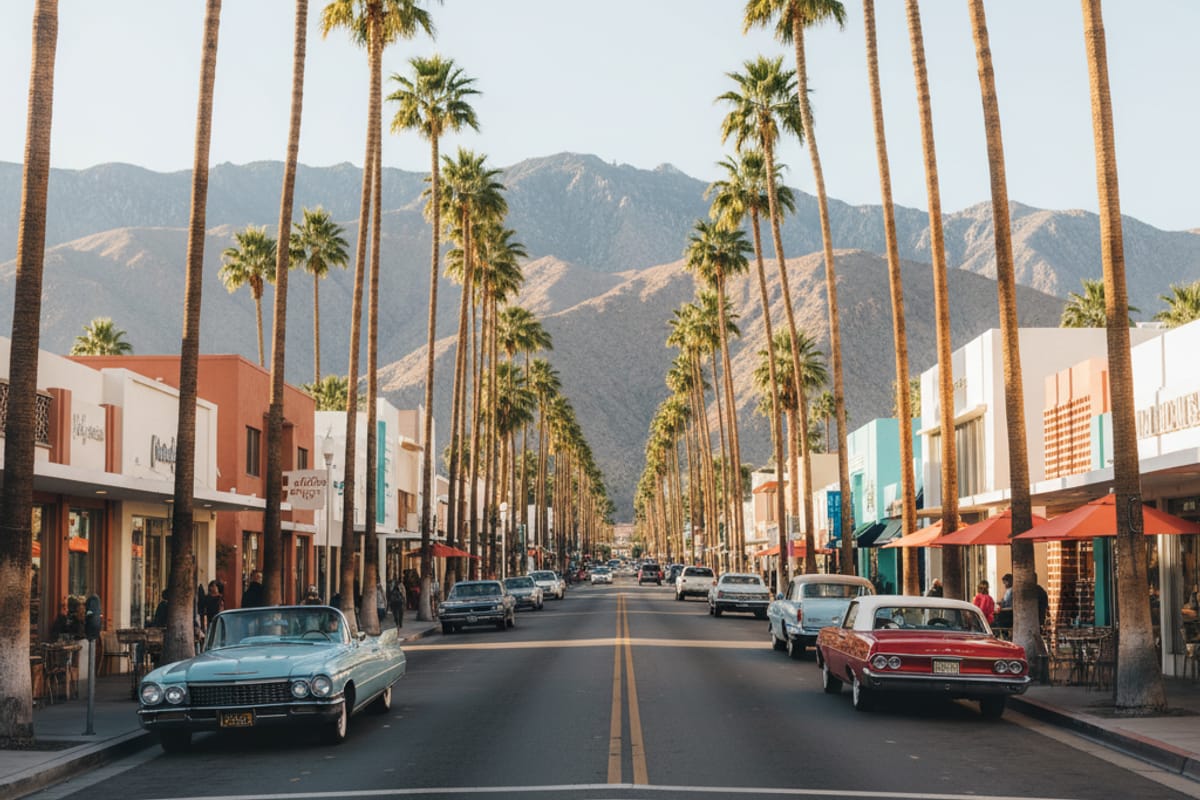 Palm Canyon Drive — the walkable heart of Palm Springs.
The Palm Springs Aerial Tramway: 8,500 Feet in 10 Minutes
The Aerial Tramway is the single must-do experience in Palm Springs, and I'll say that without hesitation. The world's largest rotating tramcar lifts you from the Sonoran Desert floor at 2,643 feet to the alpine wilderness of Mount San Jacinto State Park at 8,516 feet — a journey of nearly 6,000 vertical feet in about ten minutes. The temperature drops 30 to 40 degrees during the ride. You'll board in shorts and a t-shirt and step out into pine forests where there might be actual snow on the ground. It's surreal.
At the top, the Mountain Station has two restaurants, observation decks, a natural history museum, and access to 54 miles of hiking trails in the San Jacinto Wilderness. The Desert View Trail is an easy 1.5-mile loop with panoramic views of the Coachella Valley — on a clear day you can see all the way to the Salton Sea. For a more serious hike, the trail to San Jacinto Peak (10,834 feet) is a challenging 11-mile round trip but ranks among the best summit hikes in Southern California.
Tickets are $29.95 for adults and $17.95 for kids, and the tram runs every day except during annual maintenance in August. The ride up takes about ten minutes, and trams depart every ten minutes during peak times. Lines can get long on weekends and holidays — arriving before 10 AM or after 2 PM usually means a shorter wait. The last tram up is typically at 8 PM, with the last tram down at 9:45 PM.
The sunset from the Mountain Station is one of the most spectacular in California. The desert below turns golden, then orange, then deep purple as the sun drops behind the western mountains. Pack a light jacket — it gets cold up there fast once the sun goes down — and consider timing your visit so you ride up in late afternoon and come back down after dark. The valley lights from 8,500 feet are something you won't forget.
Pro tip: Buy your tickets online in advance, especially for weekends. The tramway occasionally sells out, and the online ticket line moves much faster than the walk-up window. Bring layers — the temperature difference between the base and summit is dramatic.
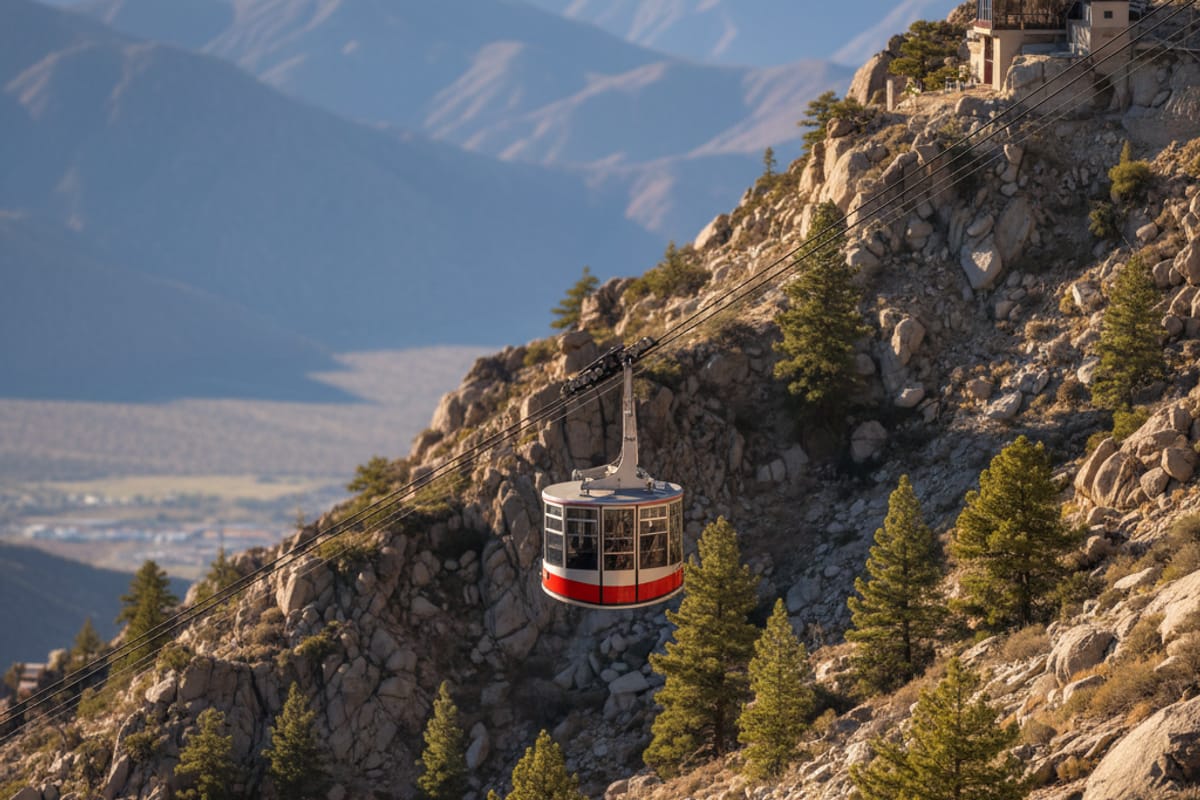 The Aerial Tramway — from desert floor to alpine wilderness in minutes.
Mid-Century Modern Architecture: Palm Springs' Greatest Treasure
Palm Springs has the highest concentration of mid-century modern architecture in the world, and that's not marketing hyperbole — it's an actual fact that has turned this small desert city into a pilgrimage site for design lovers. In the postwar boom years of the 1950s and 60s, architects like Richard Neutra, Albert Frey, Donald Wexler, and William Krisel designed hundreds of homes, hotels, and public buildings here, creating a laboratory for modernist design that was perfectly suited to the desert landscape.
The best way to see the architecture is on a guided tour with the Palm Springs Modern Committee (PS ModCom). Their weekend tours run about two hours, cost $35-50, and take you inside homes and buildings that are normally closed to the public. The guides are architects and historians who can explain why a particular roofline was designed to catch mountain breezes or why a glass wall faces north instead of south. It transforms the experience from looking at cool houses to understanding how desert modernism actually works.
If you prefer to explore on your own, pick up a self-guided tour map from the Palm Springs Visitors Center on North Palm Canyon Drive — it's free and covers the major residential neighborhoods. The Twin Palms neighborhood is an easy loop with stunning examples of the "butterfly roof" style. The Historic Tennis Club area near downtown has some of the earliest and most significant homes, including the Frey House II perched dramatically on a hillside above the Palm Springs Art Museum.
Every February, Modernism Week draws over 150,000 visitors for ten days of house tours, lectures, films, and parties. It's become one of the biggest architecture and design events in the country. If you can plan your visit around it, do — but book your hotel months in advance, as rates spike and rooms sell out fast. If February doesn't work, the smaller Modernism Week Fall Preview in October is a more relaxed alternative with many of the same tour options.
Pro tip: The Palm Springs Art Museum is free every Thursday evening from 4-8 PM. The building itself — designed by E. Stewart Williams in 1976 — is a masterclass in desert modernism, and the collection inside is surprisingly strong for a city this size.
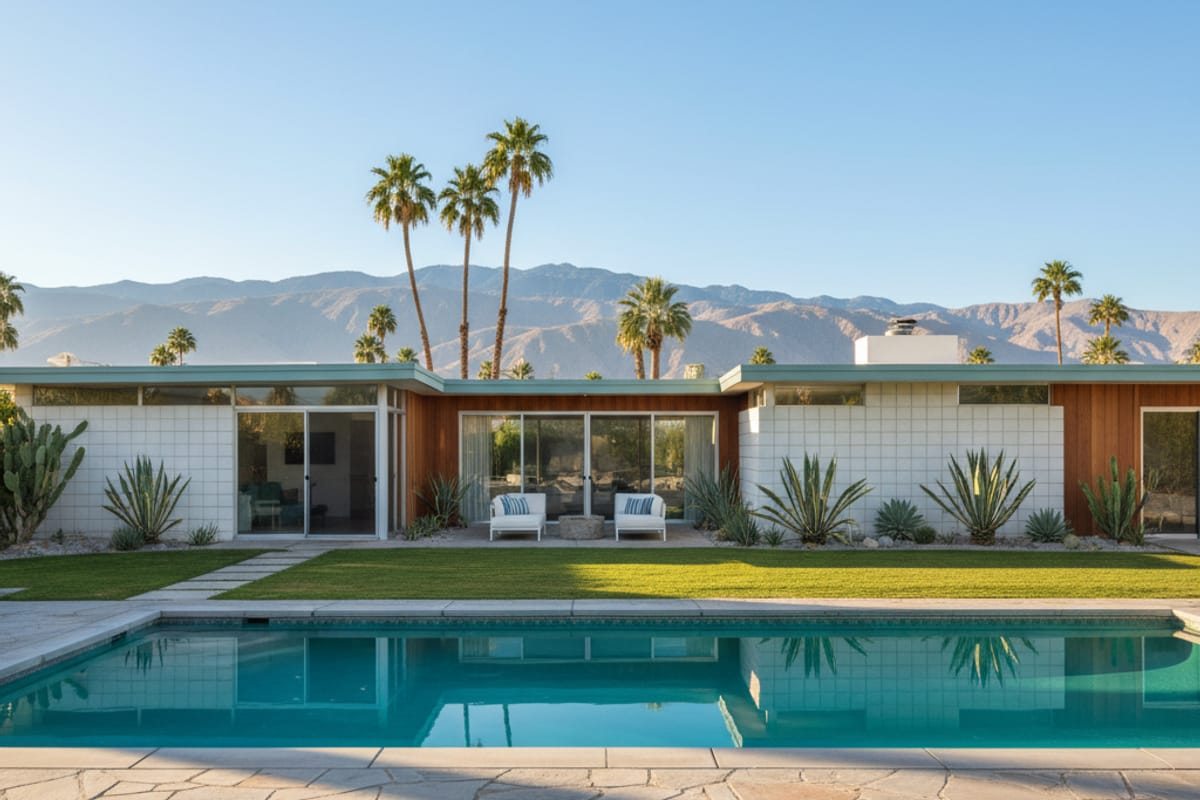 Mid-century modern architecture — the design legacy that defines Palm Springs.
Joshua Tree National Park: The Essential Day Trip
Joshua Tree National Park is about 45 minutes from downtown Palm Springs, and skipping it during a Palm Springs visit would be like going to San Francisco and not seeing the Golden Gate Bridge. The park sits at the intersection of the Mojave and Sonoran deserts, creating a landscape so otherworldly that it's been the backdrop for countless album covers, fashion shoots, and spiritual retreats. The namesake Joshua trees — those twisted, Dr. Seuss-looking yucca plants — are found nowhere else on Earth in this concentration.
Enter through the park's west entrance near the town of Joshua Tree (not the south entrance near Indio — you'd miss the best parts). The first stop should be Hidden Valley, a one-mile loop trail through a natural rock amphitheater surrounded by massive boulders. It's flat, easy, and gives you an immediate sense of the park's scale. From there, drive to Keys View for a panoramic overlook of the Coachella Valley, Salton Sea, and on clear days, Mexico. The parking lot is small and fills up by mid-morning, so go early.
For hiking, Barker Dam is an easy 1.3-mile loop that passes petroglyphs and a historic cattle-ranching dam — usually with water in winter and spring, which attracts wildlife. More ambitious hikers should tackle Ryan Mountain, a 3-mile round trip that climbs 1,000 feet to a 360-degree summit panorama. It's steep but manageable, and the view from the top is the best in the park.
Bring everything you need — water, sunscreen, snacks, a full tank of gas. There are no services inside the park beyond pit toilets at some trailheads. Cell service is nonexistent in most areas. The park entrance fee is $30 per vehicle and is valid for seven days. If you're planning to visit multiple national parks, the $80 America the Beautiful annual pass pays for itself quickly.
The town of Joshua Tree just outside the park entrance has a surprisingly good food and art scene. Crossroads Cafe serves massive breakfast burritos that are perfect fuel for a day of hiking, and the Joshua Tree Saloon is the place for a cold beer and a burger after a dusty afternoon in the park.
Pro tip: Summer temperatures in Joshua Tree regularly exceed 110°F, making most hiking dangerous. The best months are October through April when daytime highs are in the 60s-80s. If you visit in spring after a wet winter, the wildflower bloom in March-April is extraordinary.
Spa Culture: The Art of Doing Absolutely Nothing
Palm Springs has been a spa destination since long before it was a resort town. The Agua Caliente Band of Cahuilla Indians, whose reservation encompasses much of Palm Springs, have used the area's natural hot mineral springs for centuries. That tradition of therapeutic relaxation evolved into a full-blown spa culture that is central to the Palm Springs identity — this is a place where doing nothing productive is not just acceptable, it's the entire point.
The Two Bunch Palms resort in nearby Desert Hot Springs sits on a natural hot spring and offers a clothing-optional mineral pool experience that feels ancient and meditative. The water emerges from the ground at 148°F and is cooled to various temperatures across the resort's pools. Day passes run about $50-80 depending on the day, and the full spa menu includes mud wraps, desert clay treatments, and watsu (water shiatsu) sessions that are unlike anything you've experienced. It's the kind of place where people whisper and phones disappear.
Closer to town, the spa at the Parker Palm Springs is a design masterpiece — Jonathan Adler decorated the entire property and the treatment rooms look like they belong in a magazine spread. Treatments start around $175 and include access to the pool, the petanque courts, and the lemonade stand that makes you feel like you've wandered into a Wes Anderson film. The spa at the Ritz-Carlton Rancho Mirage is another high-end option with treatment rooms that have floor-to-ceiling windows overlooking the valley — getting a massage while watching the sunset over the desert is peak Palm Springs.
For a budget spa experience, many hotels offer day passes to their pools and facilities for $25-50. The Ace Hotel & Swim Club is the most popular option — $30 gets you pool access, DJs on weekends, and a scene that skews young and hip. The Saguaro hotel's pool is more colorful (literally — the building is painted in rainbow hues) and runs about $25 for a day pass. Both serve food and drinks poolside, so you can make a full day of it without spending resort-level money.
The key to Palm Springs spa culture is not rushing it. Block out a half-day minimum, leave your phone in the locker, and surrender to the heat. The desert has been teaching people how to slow down for thousands of years. Listen to it.
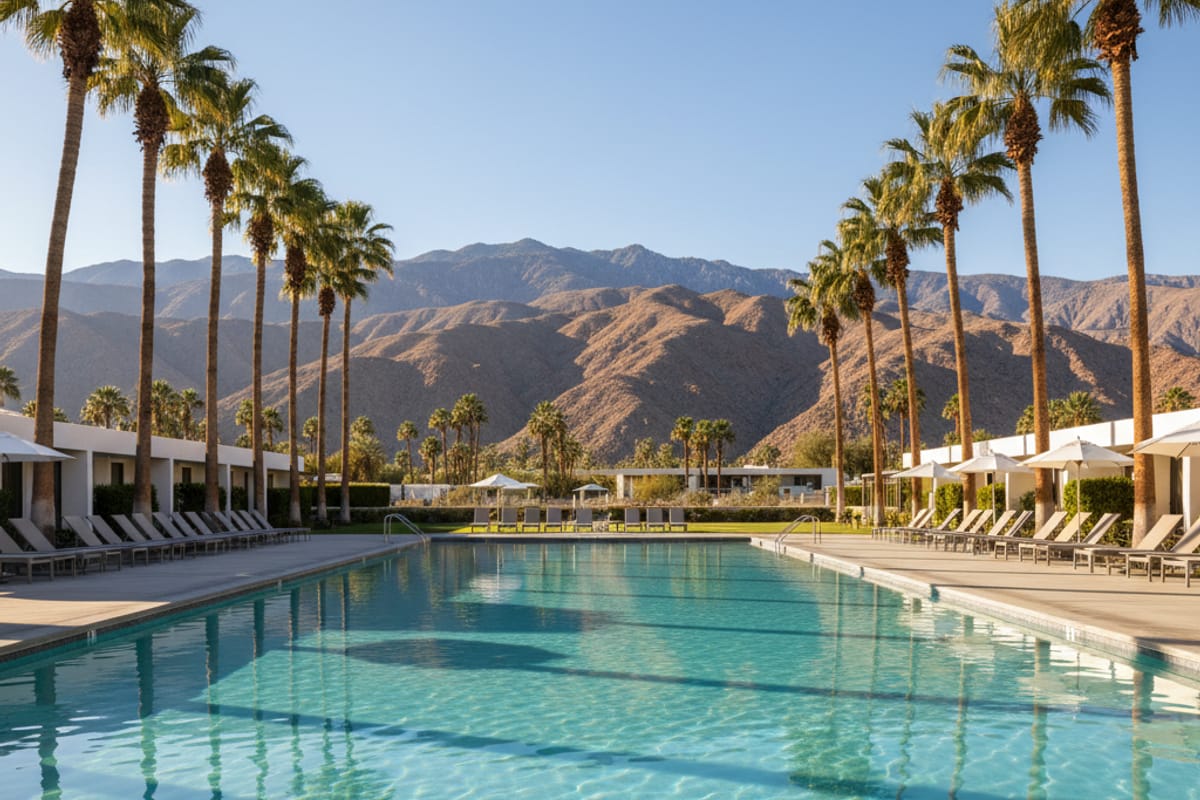 Pool culture is serious business in Palm Springs — embrace it.
Budget Breakdown: What Palm Springs Actually Costs
Palm Springs pricing follows a strict seasonal pattern that works in your favor if you're flexible. Peak season runs from January through April — hotel rates are $200-400/night at mid-range properties and $400-800+ at luxury resorts. Shoulder season (November-December, May) sees rates drop 30-40%. Summer (June-September) is the real bargain: those same $300/night hotels drop to $80-120/night because daytime temperatures hit 110-120°F. The trade-off is real — it's genuinely, aggressively hot — but the pools are open, the restaurants are air-conditioned, and the sunsets are just as beautiful.
Food is surprisingly reasonable for a resort town. Breakfast at a good cafe runs $12-18. Lunch $15-22. Dinner at a serious restaurant like Workshop Kitchen or Copley's is $40-60 per person with drinks. For budget meals, El Jefe at the Saguaro does excellent tacos for $4-5 each, Tyler's Burgers has been serving the best burger in town since 1996 for under $10, and the date shakes at Shields Date Garden in Indio ($7) are a Coachella Valley institution.
Activities break down like this: Aerial Tramway ($29.95), Joshua Tree National Park ($30 per vehicle), Palm Springs Art Museum ($16, free Thursdays), PS ModCom architecture tour ($35-50), Sunnylands ($2 suggested donation for gardens), Indian Canyons ($9), VillageFest (free). Pool day passes at hotels like the Ace or Saguaro run $25-35.
Realistic budget for a 3-day weekend in peak season: $800-1,200 per person including hotel, food, and activities. In summer: $400-600 per person for the same itinerary. The smart move is to visit in May or early November — you get pleasant 80-90°F temperatures, lower rates than peak season, and none of the summer extremes. Either way, Palm Springs delivers a resort experience that costs a fraction of what you'd pay in Hawaii, Mexico, or the Caribbean — with the added bonus of being a short drive from most of Southern California.
Pro tip: Many Palm Springs hotels offer "summer sizzler" packages that include breakfast, spa credits, or resort fee waivers. Check hotel websites directly — these deals are often better than what shows up on Expedia or Booking.com. The savings can be dramatic: a room that's $350 in February might be $89 in July with breakfast included.
Why Trust This Guide
Recommendations from locals across 240+ US cities via Recommended.app community data.
Explore More
Related guides:
This guide is part of our Palm Springs collection. Explore more guides for Palm Springs →
Palm Springs has 162 verified businesses on Recommended.app across 60 categories.
Hidden Gems Weekly
3 hidden gems, 2 local quotes, 1 home hack — every Monday. Free forever.
Unsubscribe anytime. No spam.
More from City Guides
 City Guide
Palm Springs Hidden Gems: Desert Secrets Beyond the Pool Scene
 City Guide
We Asked Palm Springs Locals Where They Actually Eat — Here's What They Said
 Home Services
Water Damage Restoration Near Me: What to Do in the First 24 Hours (2026 Guide)
 Food & Dining
Best Buffet in Las Vegas 2026: What's Still Worth It After the Great Buffet Collapse
 Food & Dining
Best Coffee Shops in Chicago 2026: 20 Cafes Worth Leaving Your Apartment For
 Food & Dining