
Last updated March 15, 2026 by the Recommended.app research team.
Food Carts: World-Class Meals for $5-10
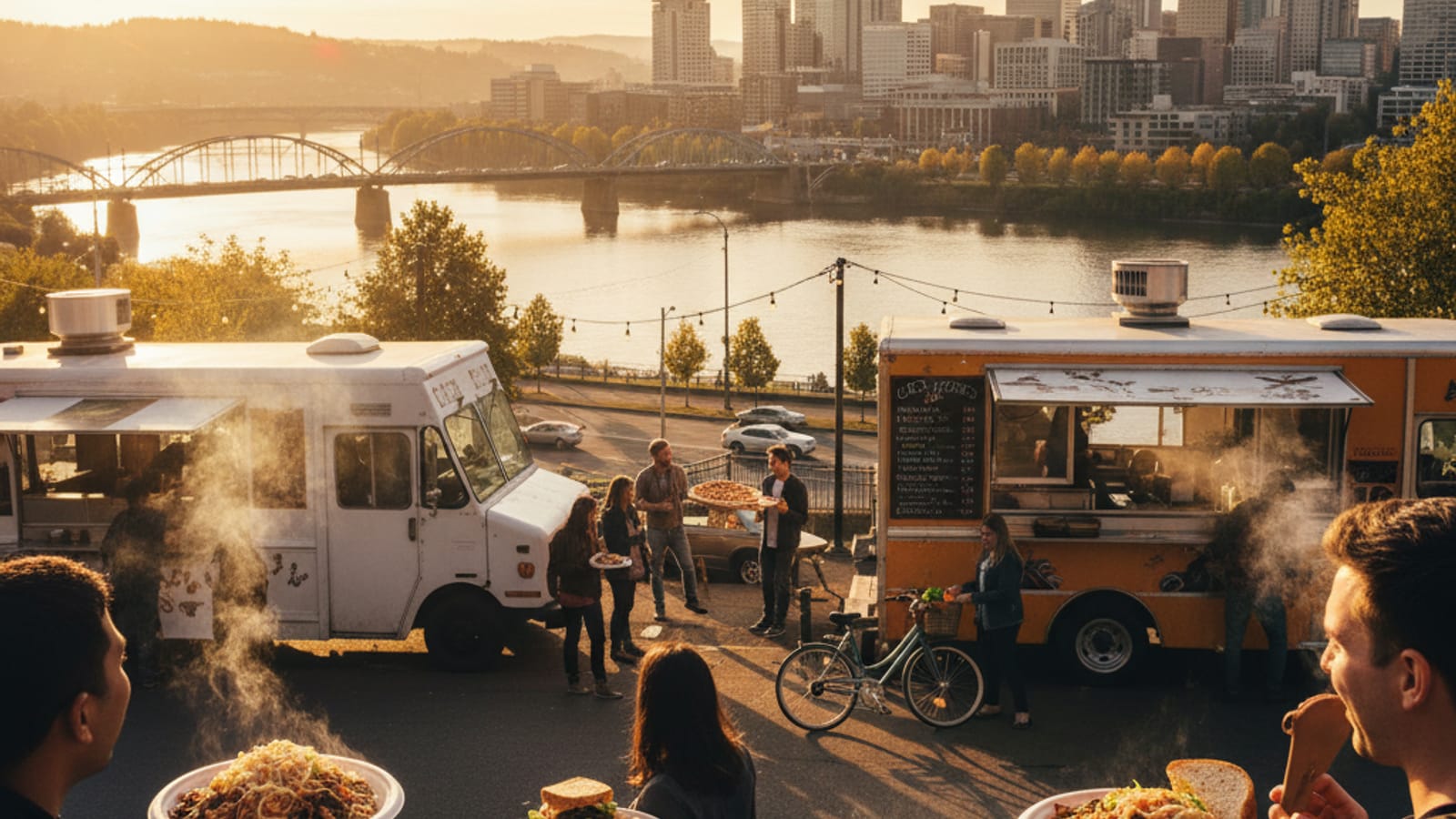
Portland's food cart scene isn't just a cultural attraction — it's the single greatest budget eating hack in any American city. With over 500 food carts serving cuisines from 60+ countries, you can eat extraordinary food for $5-10 per meal, every meal, for your entire trip. This isn't fast food compromising for price. These are passionate chefs cooking exceptional dishes at prices that make sit-down restaurants feel like a luxury tax.
The economics are simple: food carts have minimal overhead. No rent on a 2,000-square-foot dining room. No front-of-house staff. No expensive buildout. That savings gets passed directly to you. A dish that would cost $18-22 at a brick-and-mortar restaurant runs $8-12 at a food cart, and the quality is often identical — because many of Portland's best restaurant chefs started in carts and some still operate them alongside their sit-down spots.
Here's a real budget food day in Portland. Breakfast: a massive breakfast burrito from any of the Mexican carts around the city — eggs, beans, rice, cheese, salsa, wrapped in a flour tortilla the size of your forearm. Cost: $7-9. This will keep you full until mid-afternoon. Lunch: Nong's Khao Man Gai chicken and rice ($12) or two tacos from a cart on SE Division ($6-8). Dinner: a full plate at Matt's BBQ with brisket, pulled pork, and two sides ($15-18), or a massive bowl of pho from a Vietnamese cart ($10-12). Total food cost for a day of outstanding eating: $25-35.
For even cheaper meals, seek out the carts on SE 82nd Avenue — Portland's most ethnically diverse corridor. The carts here cater to local immigrant communities rather than tourists, which means larger portions at lower prices. Somali, Ethiopian, Salvadoran, Burmese, and Vietnamese carts cluster around the Cartlandia pod and along 82nd, with full meals regularly under $8.
Portland food carts also eliminate the hidden cost of restaurant dining: tipping. While you should absolutely tip at food carts (and most have tip jars or add a tip option on their card readers), the social expectation is lower than at a sit-down restaurant where 20% is standard. A $1-2 tip on an $8 meal is generous at a cart. At a restaurant, a $16 meal becomes $19+ after a 20% tip.
Don't overlook happy hours as a budget strategy. Portland has one of the best happy hour cultures in America — many restaurants offer food items at 40-60% off between 3-6 PM. Canard, one of the city's best restaurants, does $5 small plates and $6 wine during happy hour. Screen Door's weekday happy hour includes their famous fried chicken biscuit for under $10. You can eat at some of Portland's finest restaurants at food cart prices if you time it right.
Pro tip: Many food carts are cash-only, especially the smaller ones on SE 82nd Avenue. Carry $40-60 in small bills ($1s, $5s, $10s) for a day of cart eating. ATM fees add up fast if you're withdrawing $20 at a time. Some carts now accept Venmo or Cash App — look for signs.
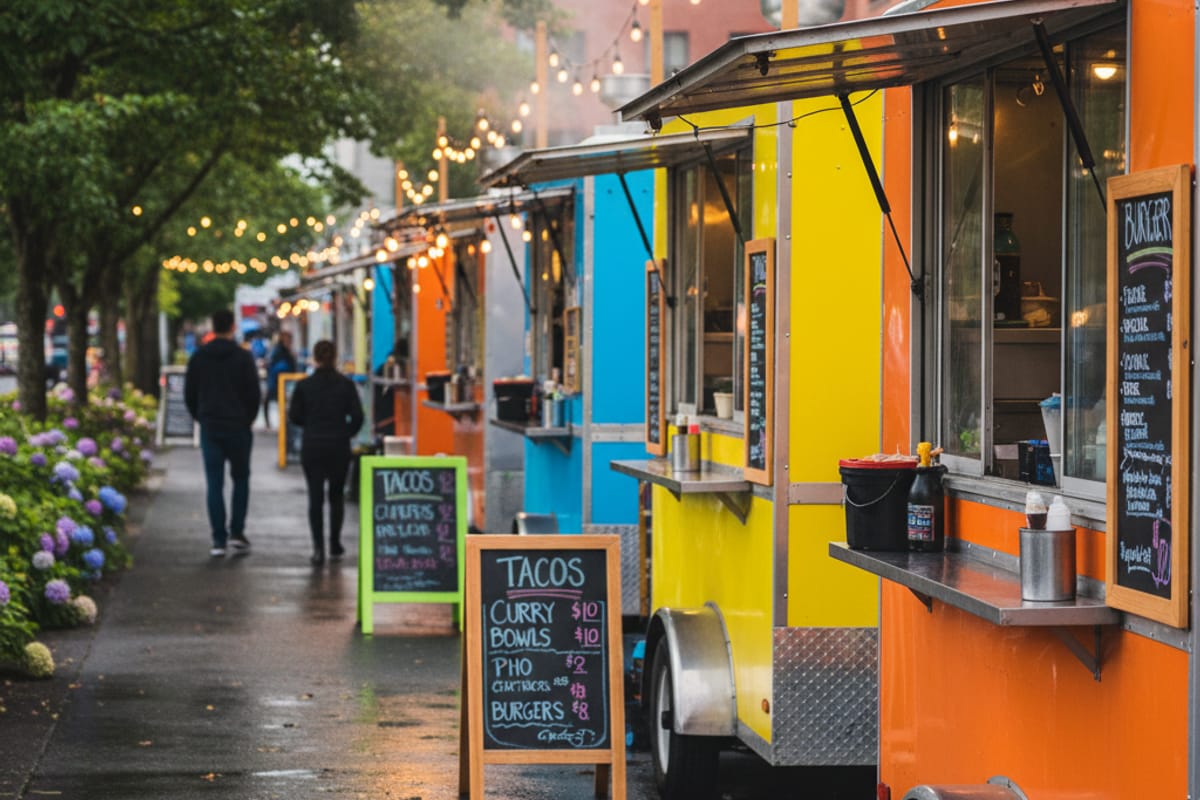 World-class food for under $10 — Portland's food carts rewrite the rules.
Free Attractions: Forest Park, First Thursdays & More
Portland has more high-quality free attractions than any city its size, and they're not the kind of 'free things to do' lists padded with 'walk around the waterfront.' These are genuinely excellent experiences that locals prioritize regardless of their budget.
Forest Park is the crown jewel. At 5,200 acres with over 80 miles of trails, it's one of the largest urban forests in America — and it's completely free. No parking fees, no entrance fees, no permits. The Lower Macleay to Stone House hike (4.5 miles round trip) takes you through ancient Douglas fir forest to a moss-covered WPA-era ruin that looks like a set from a fantasy film. The Wildwood Trail section from Pittock Mansion offers panoramic views of the city and Mount Hood. You could hike Forest Park every day of a week-long trip and never repeat a trail.
The Pittock Mansion grounds (the lawn and viewpoint, not the interior museum) are free and offer the best accessible view of Portland with Mount Hood, Mount St. Helens, and the Willamette Valley all visible on clear days. The mansion itself is $14 to tour, but the view from the grounds is the main attraction and costs nothing.
First Thursday Art Walk happens on the first Thursday of every month in the Pearl District. Galleries open their doors, pour wine, and showcase new exhibitions. It's a free evening of culture that draws thousands of people. The quality of art varies from gallery to gallery, but the overall experience — wandering through beautiful spaces, drinking free wine, engaging with Portland's creative community — is consistently excellent.
Last Thursday on Alberta Street (last Thursday of the month, April through September) is the neighborhood version — street vendors, live musicians, performance art, food carts, and a community energy that makes First Thursday feel corporate by comparison. Both events are entirely free.
Tom McCall Waterfront Park runs along the west bank of the Willamette River for 36 blocks and is Portland's main gathering space. Free to walk, run, or bike. The Eastbank Esplanade on the opposite side is a floating walkway on the river — one of the most unique urban walks in America. Connect them via the Hawthorne Bridge or the Steel Bridge for a 4-mile loop with city views the entire way.
The Portland Japanese Garden exterior grounds and the surrounding Washington Park trails are free. The interior garden has a $22 admission fee, but the 400-acre Washington Park around it — including the Hoyt Arboretum with 2,300 tree species from six continents — costs nothing. The International Rose Test Garden, also in Washington Park, is free and features over 10,000 rose bushes with views of Mount Hood.
Other freebies worth knowing: Oregon Museum of Science and Industry (OMSI) offers free admission on the first Sunday of each month. Powell's City of Books is free to browse indefinitely (just try leaving without buying something). Pioneer Courthouse Square downtown hosts free events and concerts throughout summer. Saturday Market (March through December) is free to wander, with over 300 craft vendors along the waterfront.
Pro tip: Download the free Portland Parks & Recreation app for trail maps, park locations, and event calendars. For First Thursday, start at the Blue Sky Gallery on NW 9th and work your way south — the galleries at the south end of the Pearl tend to have the best wine selections and the most interesting contemporary art.
No Sales Tax: Oregon's Built-In Discount
Oregon has no state sales tax. Zero. This is not a minor perk — it's a structural budget advantage that compounds across every purchase you make during your trip. If you're visiting from a state with 8-10% sales tax (California, New York, Washington, Illinois), you're saving $8-10 on every $100 you spend. Over a weekend of dining, shopping, and exploring, that adds up to $30-80 in real savings.
This matters most for shopping. Portland has exceptional independent retail — vintage clothing on Hawthorne, books at Powell's, records on Mississippi, antiques in Sellwood — and everything you buy is the listed price. A $45 vintage leather jacket at House of Vintage costs $45, not $49. A $25 first edition at Powell's is $25. Six bottles of Willamette Valley Pinot Noir at $30 each are $180 total, not $196.
The no-sales-tax advantage is particularly significant for bigger purchases. If you need new outdoor gear for Pacific Northwest hiking, buying it in Portland saves you 8-10% compared to buying it at home. REI, Next Adventure (Portland's local outdoor gear shop with an excellent used section), and Columbia Sportswear's flagship store in downtown Portland (the company is headquartered here) all benefit from the tax-free pricing.
A practical strategy: make a list of things you'd normally buy at home — clothing, shoes, books, wine, gifts, outdoor gear — and buy them in Portland instead. You're not spending extra money; you're redirecting spending you'd do anyway to a tax-free environment. The savings on a few bigger purchases can effectively pay for a meal or two.
One caveat: Oregon does have an income tax, and the state's hotel tax varies by city. Portland's transient lodging tax is about 11.5% on hotel rooms. So your hotel bill isn't tax-free. But everything you buy at a store, restaurant (food is taxed in some states but not in Oregon), or food cart is the listed price, period.
For grocery shopping (relevant if you're staying in an Airbnb with a kitchen), Trader Joe's and New Seasons Market (a Portland-local chain) both carry excellent prepared foods and local products at tax-free prices. A grocery run at New Seasons — local beer, artisan cheese, bread from a Portland bakery, and fruit — can produce a dinner for two for under $20.
Pro tip: If you're driving from Washington State (Seattle visitors, this means you), fill up your gas tank in Oregon. Oregon also doesn't allow self-service gas — an attendant pumps it for you. No tipping required. Gas prices in Oregon are generally comparable to Washington, so you're getting the same fuel with free service.
TriMet Transit: The $5 Day Pass That Goes Everywhere
Portland's TriMet public transit system is one of the best in any mid-size American city, and for budget travelers, it's the key to exploring the entire metro area without spending money on rental cars, parking, or rideshares.
The system has three components: buses (covering virtually every neighborhood), MAX Light Rail (five lines connecting the airport, downtown, and outer neighborhoods), and the Portland Streetcar (a circulator serving the Pearl District, South Waterfront, and close-in Southeast). All three use the same fare system.
A single ride costs $2.50 and is valid for 2.5 hours of unlimited transfers across all modes. A day pass costs $5 and gives you unlimited rides for 24 hours. For a typical weekend visit, two day passes ($10 total) will cover all your transit needs. Compare that to rideshare costs — a single Uber from the airport to downtown runs $25-35 — and the savings are immediate.
The MAX Red Line runs directly from Portland International Airport (PDX) to downtown in about 40 minutes. It costs $2.50. The same trip by taxi or rideshare costs $30-40. This single ride saves enough to buy lunch at a food cart.
The Hop Fastpass app is the best way to pay for TriMet. Download it before your trip, load it with a payment method, and tap your phone at the reader when you board. The system automatically caps your charges at the day pass rate ($5) once you've taken enough rides, so you never overpay. The app also shows real-time arrival information, which is genuinely useful — Portland buses can run a few minutes off schedule, especially in rain.
Key transit routes for visitors: MAX Blue Line from downtown to Washington Park (Powell's, Japanese Garden, Rose Test Garden). MAX Red Line from the airport to downtown and the Lloyd District. Bus #4 along SE Division Street (restaurant corridor). Bus #14 along SE Hawthorne (vintage shopping, Bagdad Theater). Bus #72 along NE Killingsworth and SE 82nd (food carts, diverse neighborhoods). Bus #44 to St. Johns and Cathedral Park.
The Columbia Gorge Express shuttle is a separate service ($5 round trip) from Gateway Transit Center to Multnomah Falls and other Gorge trailheads. It's dramatically cheaper than driving (no parking permit needed) and eliminates the stress of Gorge parking lots that fill by 9 AM on summer weekends.
Portland is also one of the most bikeable cities in America. The Biketown bike-share system (orange bikes docked throughout the city) costs $1 to unlock plus $0.10 per minute. A typical 20-minute ride across a neighborhood costs $3. The city has an extensive network of protected bike lanes, especially on Williams Avenue, the Waterfront, and the Springwater Corridor trail. In dry weather, biking is often faster than both transit and driving for cross-neighborhood trips.
Pro tip: The MAX Green and Orange lines cross the Tilikum Crossing, a bridge reserved exclusively for transit, pedestrians, and cyclists — no private cars allowed. It's the only bridge of its kind in the U.S. Ride across it at sunset for one of the best views of the Willamette River and the city skyline.
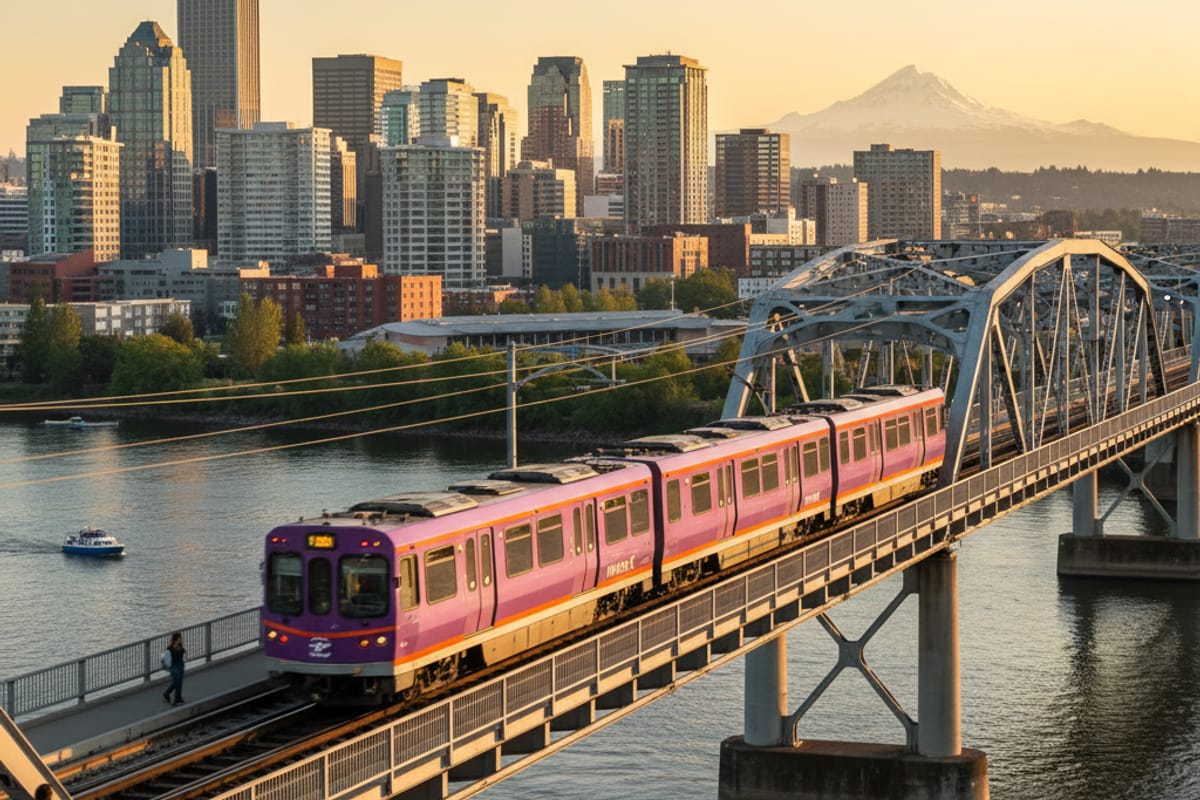 TriMet MAX — $2.50 from the airport to downtown, $5 for an all-day pass.
Cheap Neighborhoods to Stay: Where to Sleep Without Overspending
Where you sleep in Portland dramatically affects your trip budget. Downtown hotels charge $150-280/night for the location premium. But Portland's neighborhoods are so well-connected by transit and so walkable that staying outside downtown saves money without sacrificing convenience. Here's where budget-savvy travelers should look.
The Lloyd District, just across the river from downtown, is the sweet spot for budget accommodation. Hotels here run $100-150/night — 30-40% cheaper than downtown equivalents — and the MAX Light Rail connects Lloyd to downtown in five minutes. The Courtyard by Marriott Lloyd Center and the DoubleTree by Hilton Lloyd Center are both solid, functional hotels in the $110-140 range. The neighborhood isn't Portland's most charming, but the proximity to everything and the transit connections make it an excellent base.
HI Portland Hostel in the Hawthorne District is one of the best hostels in America — not just for the price ($40-55/night for a dorm bed, $90-110 for a private room), but for the location, the cleanliness, and the community vibe. It's on SE Hawthorne Boulevard, steps from vintage shops, restaurants, and the bus lines that connect to every major neighborhood. The common kitchen is well-equipped if you want to cook, and the hostel organizes free walking tours and social events. Private rooms go fast, so book early.
Airbnb and vacation rental options in residential neighborhoods are often the best value for couples or small groups. Neighborhoods to target: Sunnyside (walkable to Hawthorne and Division restaurants, quiet residential streets, listings from $70-110/night for entire apartments). Richmond (adjacent to Division Street dining, charming bungalow-lined streets, similar pricing). Montavilla (slightly further east, very affordable at $60-90/night, excellent food cart options on SE 82nd Avenue, MAX Green Line access). Kenton in North Portland ($60-90/night, quirky neighborhood character, close to the Yellow Line MAX).
For the absolute lowest cost, consider house-sitting through platforms like TrustedHousesitters, which Portland residents use frequently when traveling. You stay in someone's home for free in exchange for caring for their pets — and Portland has a lot of pet owners who travel. Annual membership is about $130, but a single Portland house-sit easily covers that cost and then some.
Camping is another option from late spring through early fall. Oxbow Regional Park, 20 minutes east of the city in the Sandy River Gorge, has tent sites for $22/night in a stunning old-growth forest setting. Champoeg State Park, 30 minutes south near wine country, offers tent sites for $19-26/night. Both have hot showers and are a short drive from Portland's neighborhoods.
Wherever you stay, the key principle is: Portland's transit and bike infrastructure make location less important than in most cities. A $70/night Airbnb in Montavilla with a 20-minute bus ride to downtown gives you a better experience than a $200/night downtown hotel, because the neighborhoods ARE the experience. The best restaurants, the best bars, the best culture — it's all in the neighborhoods, not the city center.
Pro tip: Book Portland accommodation at least 3-4 weeks in advance for summer visits (June through September) and during major events like the Rose Festival (early June). Shoulder season (April-May, October) offers the best combination of lower prices and decent weather. Winter (November-March) has the lowest rates but the most rain — though Portland in the rain has its own atmospheric charm.
Complete Budget Breakdown: 3 Days in Portland
Here's a real, tested budget for three days in Portland, broken into three tiers. These numbers are based on 2026 prices and reflect what you'll actually spend, not best-case fantasies.
BACKPACKER BUDGET ($50-70/day, $150-210 total): Accommodation: HI Portland Hostel dorm bed, $45/night x 3 = $135. Food: Food cart meals for lunch and dinner ($10 average), hostel kitchen for breakfast (grocery run: $15 for 3 days of eggs, bread, fruit, coffee), daily food cost ~$22. Activities: Forest Park (free), waterfront loop walk (free), Powell's browsing (free), First Thursday if timing works (free), Washington Park and Rose Garden (free). Transit: TriMet day passes, $5/day x 3 = $15. Daily average: $57. Three-day total: ~$170.
This isn't deprivation budgeting — at $170 for three days, you're eating at food carts that are genuinely some of the best food in the city, hiking in a 5,200-acre urban forest, browsing the world's largest bookstore, and experiencing Portland's neighborhoods on foot and by transit. The quality of experience at this price point is unmatched by any comparable American city.
MID-RANGE BUDGET ($100-150/day, $300-450 total): Accommodation: Airbnb in Sunnyside or Richmond, $90/night x 3 = $270. Food: Coffee shop breakfast ($8), food cart lunch ($12), one sit-down dinner and one cart dinner alternating ($30 average dinner), daily food cost ~$50. Activities: Forest Park (free), Columbia Gorge day trip with shuttle ($5), one museum or paid attraction ($15-25), Powell's book purchase ($15). Beer: One brewery visit with a tasting flight per day ($12). Transit: Mix of TriMet ($5/day) and one rideshare ($15). Daily average: $125. Three-day total: ~$375.
At this level, you're staying in a charming neighborhood apartment, eating a mix of food carts and restaurants, doing the Gorge trip, and having a daily brewery visit. You could add a Langbaan dinner ($95) or a wine country trip ($90 with a tour) and still stay under $500 total.
COMFORT BUDGET ($180-250/day, $540-750 total): Accommodation: Jupiter Hotel or Hotel Eastlund, $160/night x 3 = $480. Food: Good coffee shop breakfast ($12), lunch at a sit-down restaurant or upscale cart ($18), dinner at a recommended restaurant ($45-60 with a drink), daily food cost ~$80. Activities: Columbia Gorge ($5), Portland Japanese Garden ($22), one McMenamins movie ($5), Portland Art Museum ($25), wine country tour ($90). Beer/drinks: Two brewery visits or cocktail bars ($25/day). Transit: TriMet plus 2-3 rideshares ($30 total). Daily average: $210. Three-day total: ~$630.
Even at the comfort level, Portland delivers extraordinary value. You're eating at some of the best restaurants in the Pacific Northwest, staying at a boutique hotel, and doing every major activity — for what a single night at a luxury hotel costs in San Francisco.
SAVINGS MULTIPLIERS (apply to all budgets): No sales tax saves 8-10% on all purchases. Happy hours save 40-60% on restaurant food between 3-6 PM. Free activities (Forest Park, waterfront, galleries, Rose Garden) are genuinely world-class, not filler. TriMet from the airport ($2.50) saves $25-35 versus rideshare. Cooking one meal at an Airbnb or hostel kitchen saves $15-25 per meal.
The bottom line: Portland is the best value food-and-culture city in America. You can have a legitimately excellent three-day trip for under $200, or an extraordinary one for under $500. No other city with this caliber of food, beer, nature, and culture can make that claim.
Pro tip: Track your spending in real-time with a simple notes app on your phone. Portland's affordability can lead to lifestyle creep — 'it's only $12' adds up when you say it eight times a day. Set a daily budget, check it at lunch, and adjust your afternoon and evening plans accordingly. The best budget travelers aren't the ones who spend the least — they're the ones who spend intentionally.
Why Trust This Guide
Recommendations from locals across 240+ US cities via Recommended.app community data.
Explore More
This guide is part of our Portland Or collection. Explore more guides for Portland Or →
Hidden Gems Weekly
3 hidden gems, 2 local quotes, 1 home hack — every Monday. Free forever.
Unsubscribe anytime. No spam.
More from City Guides
 City Guide
First Time in Portland? Locals Wish You Knew These 12 Things
 City Guide
Portland's Hidden Gems: The Weird, Wonderful Spots Locals Love
 Travel Guide
A Perfect Portland Weekend: Coffee, Hikes & the Best Food Cart City in America
 City Guide
We Asked Portland Locals Where They Actually Eat — Here's What They Said
 Home Services
Water Damage Restoration Near Me: What to Do in the First 24 Hours (2026 Guide)
 Food & Dining